Wolfgang Tillmans photo the “Paper Drop” is one of my favorite photos on the second floor of The Photographers’ Gallery exhibits. It is a simple photo but I love the colors in the photos. It’s amazing when looking at the photo I would have never guessed that it was a piece of paper. The photo reminded of on oyster shell. The purple of the paper was a lovely color. I also enjoy how the purple color has multi shades and they blend so well.
Alina Szapocznicknow photos called “Fotorzezby-photosculptures.” These photos consist of the photographer chewing gum and posing it in certain ways and took pictures. When I first walked to the gallery it was the first photo that I came across. Like many other students I was puzzled by the photos and the objects that were there. When I did know what it was I was a bit disgusted which may have been what the photographer had in mind.
Maurizio Anzeri photos “2nd Hand Portraits” were more interesting to me. I was puzzled what would have been the meaning of the photos. Anzeri took old black and white portrait photos and stitched circler designs. One photo appears, to me, as if the photographer was attempting to make the person appear like a monkey. The photo has big circles around her eyes and large one around her mouth. Over all I think the stitches are made very well but I don’t think these photos or really any in the gallery are my aesthetic taste.
Thursday, May 7, 2009

Monday, May 4, 2009
Victorian Underclass
In the late 1888, Jack the Ripper an unidentified but
 famous serial killer who killed mostly in the Whitechapel area. At this time England had experience an increase of Irish immigrants also combining with the Jewish refugees added to the already poor conditions of London’s poverty or under class. At this time in London social classes would be “distinguished by inequalities in such areas as power, authority, wealth, working and living conditions, life-styles, life-span, education, religion, and culture.” (Victorian Web) Women of this time, class, and location in Whitechapel
  would most likely resort to prostitution as an income and were Jack the Ripper’s targeted victims. According to Wikipedia, “In October 1888, the London Metropolitan Police estimated that there were 1,200 prostitutes "of very low class" resident in Whitechapel and about 62 brothels.”
Friday, May 1, 2009
My aesthetic and Turner vs. Rothko
Characterize my aesthetic:
I would say my aesthetic would be characterized as classical and expressionist. I do enjoy pieces of art the usually have some more depth meaning to the painting then what is just placed upon the canvas. My favorite medium to be used is oil painting for the colors are much more crisped and brighter, but this is also up to change from time to time depending on the different pieces of works.
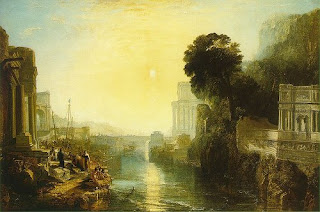
Turners first paintings are expressionistic they are vague and suggestive. His later work showed more of a defined outlines but he still held on to his talent of play with lights and colors. Comparing both Turners and Rothko’s works was difficult at first but when you get right down to it the elements are similar. Both Turner and Rothko used an expressionistic style and they also both play with the aspect of light. When looking at Rothko’s works I will admit that a more imagination is needed to see any sort of characteristics. It’s hard to imaging but at times it felt that Rothko was trying to paint a sunset or in one case I felt that I was looking at a doorway, but he uses nothing more difficult then two different colors and uses tones and tints. Turners’ earlier works were smaller and more of suggestive styles but his later works were larger and more defined there is not as much guessing involved.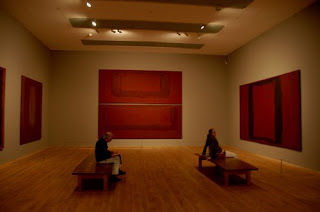
I would say my aesthetic would be characterized as classical and expressionist. I do enjoy pieces of art the usually have some more depth meaning to the painting then what is just placed upon the canvas. My favorite medium to be used is oil painting for the colors are much more crisped and brighter, but this is also up to change from time to time depending on the different pieces of works.
Turners first paintings are expressionistic they are vague and suggestive. His later work showed more of a defined outlines but he still held on to his talent of play with lights and colors. Comparing both Turners and Rothko’s works was difficult at first but when you get right down to it the elements are similar. Both Turner and Rothko used an expressionistic style and they also both play with the aspect of light. When looking at Rothko’s works I will admit that a more imagination is needed to see any sort of characteristics. It’s hard to imaging but at times it felt that Rothko was trying to paint a sunset or in one case I felt that I was looking at a doorway, but he uses nothing more difficult then two different colors and uses tones and tints. Turners’ earlier works were smaller and more of suggestive styles but his later works were larger and more defined there is not as much guessing involved.
Plague, Fire, and Greenwich
DISASTER:
Impact of the plague on London was devastating. In 1665, a hundred thousand people have died from the plague. What terrified the people was the rate and speed that the plague hit. The victim would die within days after conducting the disease. Despite the theories the people believe how they conducted the disease; it was accually transferred by rats that had fleas contaminated by bacillus. At that time rats were plentiful, and in the heat plague bacillus thrived.
Dr. John Snow created Ghost Maps that marked deaths in London in 1832. Snow then linked the deaths to the water source for the quantity of deaths around the pump. At the John Snow pub is where the contaminated pump is located and is marked by a red granite stone.
The Great Fire of London in 1666 left an impact on the people. The Monument was designed by Sir Christopher Wren in memory of the great disaster. The monument is two hundred and two feet high and made of stone. The height of the monument, 202 feet is the distance to the location that the fire started at the King’s Baker’s shop, Thomas Farynor.
Geocaching is a very good and interesting instrument to use to find these places. It’s a fun way to learn something new and visit places I don’t think I would have seen before.
GREENWICH
This week we did a geocached in Greenwich. Our destination took us to the royal observatory where the British Prime Meridian of the World is located at. This is where the north longitude is 0 00’ 00”. But our GPS didn’t state the same thing. Instead when we walked a bit away our GPS then said that we were at the Prime Meridian. The two data bases have two different definitions of where the Prime Meridian is located. What I thought was interesting is that there is no identification or marking stating that this was a different Prime Meridian.
Impact of the plague on London was devastating. In 1665, a hundred thousand people have died from the plague. What terrified the people was the rate and speed that the plague hit. The victim would die within days after conducting the disease. Despite the theories the people believe how they conducted the disease; it was accually transferred by rats that had fleas contaminated by bacillus. At that time rats were plentiful, and in the heat plague bacillus thrived.
Dr. John Snow created Ghost Maps that marked deaths in London in 1832. Snow then linked the deaths to the water source for the quantity of deaths around the pump. At the John Snow pub is where the contaminated pump is located and is marked by a red granite stone.
The Great Fire of London in 1666 left an impact on the people. The Monument was designed by Sir Christopher Wren in memory of the great disaster. The monument is two hundred and two feet high and made of stone. The height of the monument, 202 feet is the distance to the location that the fire started at the King’s Baker’s shop, Thomas Farynor.
Geocaching is a very good and interesting instrument to use to find these places. It’s a fun way to learn something new and visit places I don’t think I would have seen before.
GREENWICH
This week we did a geocached in Greenwich. Our destination took us to the royal observatory where the British Prime Meridian of the World is located at. This is where the north longitude is 0 00’ 00”. But our GPS didn’t state the same thing. Instead when we walked a bit away our GPS then said that we were at the Prime Meridian. The two data bases have two different definitions of where the Prime Meridian is located. What I thought was interesting is that there is no identification or marking stating that this was a different Prime Meridian.
Friday, April 24, 2009
TAS- Aesthetics Dinner

On Tuesday night we all joined again to dine at TAS down in Bloomsbury Square, TAS is a Turkish cuisine restaurant. To begin with I would like to state that I still wasn’t hundred percent better from getting sick a few nights before so I wasn’t completely thrilled with the idea of eating food. When you walk into the restaurant the setting is appropriate for a Turkish restaurant. Walls and pillars are tiled and there is a mosaic on one wall. One side of the restaurant has mirrors hanging to make it appear as if the room is larger than it is. Our class sat next to the window, outside the window there were potted plants that set a nice frame for the busy road the restaurant was located by. The bar and grills are displayed openly on the right side of the room, when we walk out we could thank the cooks that prepared such a wonderful meal.
To start off the meal we were given a set menu of five different starters. They were all taste but I particularly liked the humus but I’m also already a fan of humus. Another started that I enjoyed was the feta cheese and spinach triangle pastures called Borek. Some of the other starters were: Zeytin Yagli Patlican, Tabule, Manca, Zeytin Yagli Bakla, and Sebzeli Kofte (Falafel).
For our main dish I chose to try the mixed grilled called Karisik Izgara. The dish consists of chicken, beef, and minced lamb. The meats were seasoned and cooked deliciously with Orzo on the side, everything went well together. Along with our meal we were served house wines. Their house white wine was a crisp and dry wine and the red house wine was a syrah wine that I suggest is left to breath for a while before drinking, for me it was a bit to sharp for me to begin with. The red wine has a berry and spice flavor that went well with my meat dish. Overall the meal and atmosphere of the restaurant was appealing and enjoyed.
Review is also posted on Yelp.co.uk: http://www.yelp.co.uk/biz/tas-restaurant-london-2
Regent's Canal

On Tuesday for class we geocached along the Canal route. It was a beautiful walk, I could not believe that we walk by it every day on our way to the underground station and home. I hadn’t expected to have boats and people living on the canal. What was also not expected but extremely welcomed was a restaurant on the canal itself. Further along, the canal goes by the Regents Park which was pleasant to stop by and help Manley and other students find our last geocache prize in the bushes. Next we went to Camden Town to start a new series called The London Rainbow. There we saw where people would keep their horses that were used to pull boats up the canal.

After walking along the canal I assumed that the infrastructure system was used to move from one place to another. After doing some research I did find that they were indeed used to transport belongings and supplies from one location to another. The main purpose for the canal was to deliver coal to people cheaper. The plans were set by the Duke of Bridgewater who had an enthusiasm for coal. When the canal was made it decreased the price of coal by half.
All information was sited from http://www.canalmuseum.org.uk/history/ukcanals.htm
Thursday, April 23, 2009
Whitechapel and The National Gallery
Whitechapel: 
At the Whitechapel I was able to see the Guernica by Picasso. When you stand there long enough you can start to understand what is going on in the painting. The painting begins to make more since and flows together. It’s a caption of the Spanish Civil war, it brought many people’s attention to the matter. As for the rest of the Galleries I was not overly impressed it was nothing like the Tate Modern or Saatchi.

At the Whitechapel I was able to see the Guernica by Picasso. When you stand there long enough you can start to understand what is going on in the painting. The painting begins to make more since and flows together. It’s a caption of the Spanish Civil war, it brought many people’s attention to the matter. As for the rest of the Galleries I was not overly impressed it was nothing like the Tate Modern or Saatchi.
The National Gallery
Jan Van Eyck painting Arnolfini Portrait is my favorite in the National Gallery. What I love about this painting is how Van Eyck puts his own special touch into the painting. Not only does he sign the painting “Jan Van Eyck was here 1434” which is unheard of artist putting any sort of mark on their paintings. Jan Van Eyck also is so bold as to put a self portrait of himself as a reflection in the mirror. Jan Van Eyck has particular attention to the lighting in the painting. The golden chandelier above the couple is a good example of this. Outside the window it is apparent that it is light outside. Where the light is coming through the window the chandeliers has a shine and lightness to it on the other side. To the right in the shadows it is darker and daunt. Another play with light is that Giovanni Arnolfini’s wife has a shadow behind her. Even the mirror you can tell that there is a shadow to the right of it. Textures are so incredible in depth in detail, the folds and lace on her head scarf on the wife. Arnolfini coat and the dog at his feet are detailed work of fur textures. The incredible detail put into the rug is amassing, colors and small in detail. From approaching the painting from afar it is interpreted that the wife is pregnant by how she is holding up her dress but it is stated that it is a contemporary fashion of the times. What I find interesting is why did Jan Van Eyck choose to paint the pair without shoes on but to only put the shoes besides them? Is this to show that the two are at their house and are comfortable with their surroundings. This is also a contrast to the formal outfits that they are wearing. Over all this piece of art is fascinating to me, in that it shows great texture and lighting. Also the symbolic meaning along with artist rebelling that is intertwined in the painting.
Jan Van Eyck painting Arnolfini Portrait is my favorite in the National Gallery. What I love about this painting is how Van Eyck puts his own special touch into the painting. Not only does he sign the painting “Jan Van Eyck was here 1434” which is unheard of artist putting any sort of mark on their paintings. Jan Van Eyck also is so bold as to put a self portrait of himself as a reflection in the mirror. Jan Van Eyck has particular attention to the lighting in the painting. The golden chandelier above the couple is a good example of this. Outside the window it is apparent that it is light outside. Where the light is coming through the window the chandeliers has a shine and lightness to it on the other side. To the right in the shadows it is darker and daunt. Another play with light is that Giovanni Arnolfini’s wife has a shadow behind her. Even the mirror you can tell that there is a shadow to the right of it. Textures are so incredible in depth in detail, the folds and lace on her head scarf on the wife. Arnolfini coat and the dog at his feet are
 detailed work of fur textures. The incredible detail put into the rug is amassing, colors and small in detail. From approaching the painting from afar it is interpreted that the wife is pregnant by how she is holding up her dress but it is stated that it is a contemporary fashion of the times. What I find interesting is why did Jan Van Eyck choose to paint the pair without shoes on but to only put the shoes besides them? Is this to show that the two are at their house and are comfortable with their surroundings. This is also a contrast to the formal outfits that they are wearing. Over all this piece of art is fascinating to me, in that it shows great texture and lighting. Also the symbolic meaning along with artist rebelling that is intertwined in the painting.
Visit http://www.nationalgallery.org.uk/cgi-bin/WebObjects.dll/CollectionPublisher.woa/wa/work?workNumber=ng186 to be able to zoom in onto this piece of work.
Subscribe to:
Posts (Atom)
